
What is AI Development? A Practical Buyer's Guide


Let’s be very clear, we’re not going to write about “vibe-coding” in this blog post. Rather, we’re going to explore the additional complexity that comes with implementing artificial intelligence as a solution to a technical problem.
AI technology has advanced rapidly in recent years, yet it isn’t really new. Deep neural networks have been researched since the 1950s. And in 1985, the AI research market was already worth over 1 billion US dollars.
So, what’s changed?
We now have massive amounts of available computational power, due to cloud-based infrastructure that is accessible on-demand.
Big tech has access to extremely large data-sets from decades of digital record keeping.
Open-source frameworks provide free access to implementing AI solutions and reduce the barrier to entry.
These shifts have changed the field of what used to be academic research to a practical engineering discipline.
AI development is the process of creating computer systems that include an AI component as part of the system. It includes image recognition, pattern detection, decision-making, language recognition and much more. Unlike traditional software, an AI system's behaviour comes from data and a model rather than only from rules you wrote. Most business systems today do not retrain themselves; they use a pre-trained model, and the quality changes when the model, the prompt or your data changes.
Challenges of AI development
Developing AI systems introduce new layers of complexity. Just like a software engineer needs to have understanding of the operating systems their applications run on, an AI engineer needs to have understanding of the AI technologies they’re implementing within their solutions.
As an AI developer you need to understand machine learning models, deep learning architectures, neural networks, vector spaces, evaluation metrics and even make decisions on ethical grounds regarding the use of AI.
Fortunately for the AI developers, large language models (LLMs) have made it easier to work on the traditional parts of software development, because they still face challenges like deployment, system scalability and frontend development. After all, you still need a way to interact with the system and the system should be available for use.
AI development can be powerful, but it’s not an automated process. You cannot just throw a client’s email in a model and expect a fully worked out computer system as a result. It requires careful thought, iterative development, testing, and a deep understanding of the problem you’re trying to solve.
AI development also introduces a new type of error: unusable computer output. Any traditional system error was a human error, bugs in the code. But now the computer can give strange or fundamentally wrong results, sometimes called "hallucinations”. The AI developer has to know how to deal with these kinds of errors by implementing new validation strategies, model fine-tune training and fallback logic.
Another note is that due to the fast advancements within the AI technologies available, an AI developer has to continuously stay up-to-date with new emerging tools to remain competitive within the landscape.
What can AI do for a business today?
Most useful AI projects are not exotic. They are language models or classifiers attached to an ordinary system. These are the use cases we see work, each with the limit you should plan for.
| Use case | What it does well | Honest limit |
|---|---|---|
| Customer support assistant | Answers common questions from your own documents, drafts replies for staff | Will sometimes answer confidently and wrongly; needs a handover to a human |
| Document processing | Extracts fields from invoices, contracts, forms into structured data | Poor scans and unusual layouts fail; someone must review low-confidence results |
| Search over your own content | Finds answers in manuals, tickets, wikis by meaning, not keywords | Only as good as the documents; outdated or contradictory files give outdated answers |
| Classification and routing | Tags emails, leads or tickets and sends them to the right team | Edge cases and new categories need monitoring |
| Drafting and summarising | First drafts, meeting summaries, product descriptions | A human still owns the final text |
| Forecasting and anomaly detection | Demand, churn, fraud signals from your historical data | Needs enough clean history; cannot predict what has never happened |
If a rule can solve the problem ("if the order is over 5,000 baht, ask for approval"), write the rule. AI earns its place where the input is messy, language-heavy or too varied for rules. For the technical background, see the foundations of AI.
What does an AI project look like, step by step?
- Define the problem and the success measure. "Reduce first-response time on support by half" is a goal. "Add AI" is not.
- Check the data. Do you have it, may you use it, and is it clean enough? This is where many projects change scope.
- Build a small prototype. A few days of work with a hosted model tells you whether the idea is feasible at all.
- Build an evaluation set. Collect 50 to 200 real examples with the correct answers, and score every change against them. Without this you are guessing.
- Build the real system. Prompts or retrieval, validation of outputs, fallback to a human, logging, and the interface people actually use.
- Integrate. Connect to your CRM, ERP, inbox or website, with permissions and error handling.
- Launch to a small group, then monitor. Track quality, cost per request, response time and user corrections. Models, prompts and your own data change, so quality drifts.
Steps 2, 4 and 7 are the ones people skip, and they are the difference between a demo and a product. The same gap exists for any prototype; see is my vibe-coded product ready?
What drives the cost of an AI project?
- Model and API usage. Hosted models are billed per token (roughly three-quarters of a word). Input and output tokens are priced separately, and output costs more.
- Data preparation. Cleaning, labelling, permissions and getting data out of old systems is often the biggest line in the first project.
- Evaluation. Building test sets and reviewing results takes real time from people who know your business.
- Integration. Connecting to your existing systems, login, and the user interface.
- Monitoring and maintenance. Dashboards, alerts, prompt and model updates, and regular quality review.
Example: what API usage costs
As of October 2026, Anthropic lists these API prices per million tokens on its pricing page:
| Model | Input | Output |
|---|---|---|
| Haiku 5.5 (prompts up to 100K tokens) | $0.10 | $0.50 |
| Sonnet 5.5 | $2 | $10 |
| Opus 5.5 | $4 | $20 |
| Fable 5.1 | $10 | $50 |
The page also lists a 50% saving for batch processing and much cheaper reads for cached prompt text. Prices change often, so check the vendor page before budgeting.
A quick calculation of our own: a support assistant handling 1,000 conversations a day, each with about 3,000 input and 500 output tokens, uses 3 million input and 0.5 million output tokens daily. On Sonnet 5.5 that is $6 + $5 = $11 per day, roughly $330 per month. The model bill is often small; the people and engineering around it are not. That is why the cost is not zero even when the tool is cheap.
Build or buy?
- Buy when the problem is common (meeting notes, generic chatbots, transcription) and a product already does it well. You pay a subscription and accept its limits.
- Build when the AI touches your own data, workflow or customers, when you need control over behaviour and cost, or when it is part of what you sell.
- Combine in most cases: buy the model through an API, build the parts around it that are specific to you.
The broader trade-off is covered in build it or buy it: the calculation has changed. If you want a team to build it with you, see our AI development service and some past projects.
What are the risks?
Privacy and data protection
Whatever you send to a model leaves your systems. Decide what may be sent, check the vendor's data-retention and training terms for your plan, remove personal data where you can, and check local rules such as Thailand's PDPA or GDPR if you serve EU customers.
Hallucinations
Models can state false things fluently. Reduce the risk by answering only from supplied documents, validating outputs against a schema or database, showing sources, and routing uncertain cases to a person. You cannot reduce it to zero, so design for the failure.
Vendor lock-in
Prompts, fine-tuned models and special features tie you to one provider. Keep the model behind one interface in your code, keep your evaluation set, and you can test a cheaper or better model in an afternoon.
Cost surprises and quality drift
Set usage limits and alerts, and re-run your evaluation set after every model or prompt change.
Final thoughts
While there are many AI technologies available through APIs for fast implementation, AI development isn’t just about writing a good prompt and vibe-coding an interface on top of it. Learning how to trust, verify and correct the machine’s output is what separates a proof-of-concept from a production-ready AI solution. Before thinking of building an AI driven solution, ask yourself:
Do we have enough quality data?
How can we measure success?
Are we ready to maintain a system that learns and adapts over time?
AI isn’t the future, it’s the present. But it’s an engineering discipline like any other which requires knowledge, critical thinking and creativity to actually produce results.
Not every AI task needs a large language model. For fast, structured decisions such as routing or scoring, read LLM vs System One models.
Sources
Frequently asked questions
What is AI development?
It is building software that includes an AI component, such as a language model or classifier, for tasks like answering questions, extracting data or routing requests. Most of the work is still engineering around the model.
How much does AI development cost?
It depends on scope. Model API fees are billed per token and can be a few hundred dollars a month for a busy assistant, while data preparation, evaluation, integration and monitoring make up most of the project cost.
How are AI APIs priced?
Per million tokens, with separate prices for input and output. In October 2026 Anthropic lists Sonnet 5.5 at $2 input and $10 output per million tokens, with 50% off for batch processing.
Should I build or buy an AI solution?
Buy when the problem is common and a product already solves it. Build when the AI uses your own data or workflow, and in most cases combine a bought model with custom software around it.
Can AI make mistakes in a business system?
Yes. Models can produce confident but wrong answers. Use answers grounded in your documents, validate outputs, and send uncertain cases to a person.
How do I avoid vendor lock-in with AI?
Keep the model behind a single interface in your code and keep your own evaluation set. Then you can test another model and switch without rewriting the system.
Related articles
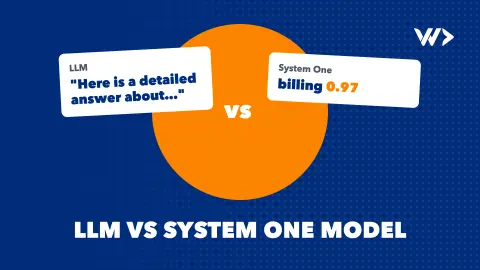
LLM vs System One Model: Claude and ChatGPT vs Jev and SubQ Snap
LLMs like Claude and ChatGPT write answers; System One decision models like Jev and SubQ Snap pick them. The difference, prices and when to use which.

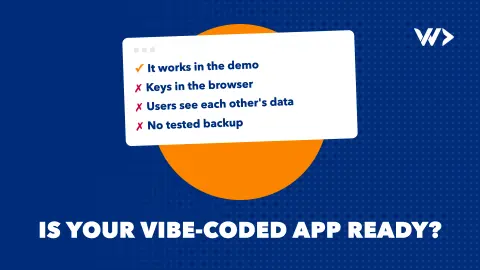
Is My Vibe-Coded Product Ready for Real Users? A Launch Checklist
Built your product with Lovable, Bolt, Cursor or Claude? Check secrets, data access, payments, backups, monitoring, privacy and code ownership before you launch.
How we take total control of our operations at WDDW
As WDDW grew, so did our SaaS costs. Here's why we built our own internal tools, and how they improved efficiency, reduced costs, and gave us full control.


